HIPAA Compliance for Dental Offices in Miami: The 2026 Managed IT Guide
In 2026, the landscape of healthcare data security is more complex than ever, and Miami's vibrant dental community is squarely in the regulatory spotlight. The Office for Civil Rights…
Table of Contents
- Why Miami Dental Practices are Prime Targets for HIPAA Audits
- The Technical Safeguards: Securing Digital Patient Data
- DIY IT vs. Managed IT Services: A Cost Comparison
- The Miami Dentist’s HIPAA Roadmap: Local Audits and Disaster Recovery
- RANGO Technologies: Your Local IT Partner for HIPAA Alignment
Why Miami Dental Practices are Prime Targets for HIPAA Audits
In 2026, the landscape of healthcare data security is more complex than ever, and Miami's vibrant dental community is squarely in the regulatory spotlight. The Office for Civil Rights (OCR), the enforcing body for HIPAA, no longer focuses solely on large hospital systems. Increasingly, they are scrutinizing small to mid-sized practices, where they often find significant compliance gaps. For a dental office in South Florida, navigating HIPAA is not just about avoiding fines; it's about protecting your patients, your reputation, and the business you've built.
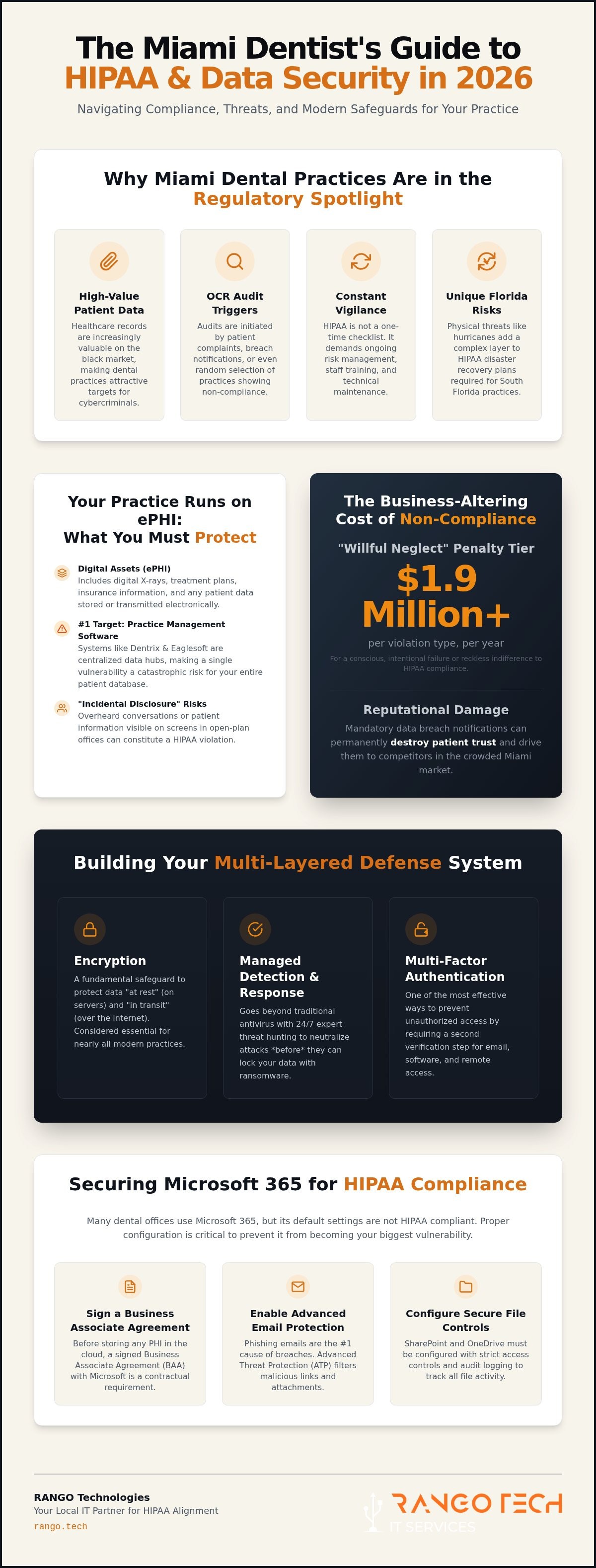
- The rising cost of dental data breaches: The value of a single healthcare record on the black market continues to climb. This makes dental practices, with their rich databases of patient information, highly attractive targets for cybercriminals.
- How the OCR identifies audit targets: Audits can be triggered by patient complaints, data breach notifications, or even random selection. The OCR actively investigates practices that show patterns of non-compliance.
- The difference between "being compliant" and "staying compliant": HIPAA is not a one-time checklist. It requires ongoing risk management, staff training, and technical maintenance. A security measure that was adequate last year may be obsolete today.
- Why South Florida practices face unique scrutiny: Beyond the typical cyber threats, Miami dental offices must contend with physical risks like hurricanes, which add another layer to HIPAA's disaster recovery requirements.
Understanding PHI in the Modern Dental Office
Protected Health Information (PHI) extends far beyond paper charts. In a contemporary dental practice, nearly every digital asset contains PHI. Understanding its scope is the first step toward securing it.
- Digital X-rays, treatment plans, and insurance info: These are all forms of electronic PHI (ePHI). This data, stored on servers, workstations, and in your practice management software, must be protected under the HIPAA Security Rule.
- The risk of "incidental disclosure": In an open-plan office, a patient overhearing a conversation about another patient's treatment or seeing a screen at the front desk can constitute a HIPAA violation.
- Why your practice management software is the #1 target: Software like Dentrix, Eaglesoft, or Open Dental is a centralized repository of your most valuable data. A single vulnerability can expose your entire patient database to hackers.
The Financial and Reputational Stakes
A HIPAA violation is more than a technical misstep; it's a business-altering event. The consequences can be severe, impacting both your finances and the trust you've cultivated within the Miami community.
- Analysis of recent HIPAA settlement amounts: The OCR has shown a consistent willingness to levy substantial fines, even against smaller practices. Penalties are based on the level of negligence, with many settlements reaching tens or hundreds of thousands of dollars.
- How a breach notification destroys patient trust: Being legally required to notify every patient of a data breach can seriously damage your practice's reputation. In a competitive market like Miami, patients have many choices, and they will quickly leave a practice they no longer trust.
- The "Willful Neglect" penalty tier for 2026 is defined as a conscious, intentional failure or reckless indifference to the obligation to comply with HIPAA, with fines that can exceed $1.9 million per violation type per year.
The Technical Safeguards: Securing Digital Patient Data
The HIPAA Security Rule mandates specific technical safeguards to protect ePHI. This isn't about buying a single piece of software; it's about building a multi-layered defense system managed by experts who understand both technology and healthcare regulations.
- Encryption for data at rest and in transit: Under HIPAA, encryption is an "addressable" safeguard. This means you must implement it if it's a reasonable and appropriate measure for your practice. If not, you must document why and use an equivalent alternative. For nearly all modern dental offices, encrypting server hard drives and data sent over the internet is considered a fundamental and necessary security measure.
- Why traditional antivirus fails against 2026 ransomware: Signature-based antivirus software cannot keep up with the new, sophisticated ransomware strains that target healthcare providers. These attacks can lock up your patient data, grinding your operations to a halt.
- The role of Managed Detection and Response (MDR): MDR is a modern cybersecurity service that goes beyond prevention. It involves 24/7 threat hunting by security professionals who actively look for and neutralize threats inside your network before they can execute an attack.
- Implementing Multi-Factor Authentication (MFA): Requiring a second form of verification (like a code from a mobile app) to log into email, practice management software, and remote access systems is one of the most effective ways to prevent unauthorized access.
Securing Microsoft 365 for Dental Teams
Many Miami dental offices rely on Microsoft 365 for email and collaboration. While a powerful tool, its default settings are not configured for HIPAA compliance. Proper configuration is critical to prevent it from becoming your biggest vulnerability.
- Configuring Business Associate Agreements (BAAs): Before you can store any PHI in a cloud service like Microsoft 365, you must have a signed BAA with the provider. RANGO Technologies manages this process to ensure your cloud environment is contractually aligned with HIPAA requirements.
- Email threat protection: Phishing emails are the leading cause of data breaches. Advanced Threat Protection (ATP) for Microsoft 365, combined with staff training, can filter out malicious emails and prevent a staff member's single click from becoming a costly breach.
- SharePoint and OneDrive: These tools must be configured with strict access controls and audit logging to ensure only authorized staff can access patient files and that all activity is tracked.
Network Administration and Automated Patching
Your office network is the backbone of your digital operations. Without proactive management, it becomes a liability, riddled with vulnerabilities that cybercriminals are actively seeking to exploit.
- The danger of "legacy" dental hardware and outdated operating systems: Equipment like panoramic X-ray machines often runs on old, unsupported operating systems like Windows 7. These systems no longer receive security updates, making them an open door for attackers.
- Why timely patching matters under the Security Rule: The Security Rule requires a process for protection from malicious software. Automated patch management is a practical way to keep systems updated promptly after security fixes are released; the requirement is the protective process, not automation itself.
- Proactive monitoring helps detect unusual network activity in real time, so security experts can isolate a compromised device before sensitive patient files are stolen.
DIY IT vs. Managed IT Services: A Cost Comparison
For a regulated dental practice, the "Break-Fix" model—calling an IT person only when something breaks—is a recipe for non-compliance and unexpected costs. A managed services approach provides the predictability and proactive oversight that HIPAA demands.
- The hidden costs of "Break-Fix" IT: You pay for emergency repairs, but you also pay in downtime, lost productivity, and the enormous risk of a data breach that a proactive provider would have prevented.
- How flat-rate IT support aligns with dental practice budgeting: With a Managed Service Provider (MSP) like RANGO, you pay a predictable monthly fee. This covers all monitoring, maintenance, and support, allowing you to budget for IT as a fixed operational expense, not a series of emergencies.
- The "compliance gap" that occurs when non-experts handle IT: A generalist "IT guy" may be able to fix a printer, but they rarely have the specialized knowledge to configure systems, document processes, and respond to incidents in a HIPAA-compliant manner.
- Why "local" matters: When your server is down and you can't access patient records, you need an engineer on-site immediately. Relying on a remote-only provider can turn a minor issue into a full day of lost revenue.
The Risk of the "IT Guy" Mentality
Relying on an informal or underqualified IT resource introduces unacceptable risks for a modern dental practice. This approach lacks the structure, documentation, and expertise required to withstand an OCR audit.
- Why entry-level IT support misses complex HIPAA requirements: True HIPAA-aligned IT involves more than just setting up a firewall. It requires deep knowledge of access controls, audit logging, risk analysis, and breach notification protocols.
- The lack of documentation and audit trails: If the OCR audits you, they will ask for documentation of your risk assessments, policies, and security measures. A "Break-Fix" provider rarely supplies this level of formal documentation.
- How RANGO’s senior engineers provide senior-level service: We don't employ a tier-one helpdesk. When you call RANGO, you are speaking directly with a senior engineer who has the authority and expertise to solve your problem efficiently.
Flat-Rate Security vs. Hourly Billing
The payment model of your IT provider directly influences the quality of your security. The hourly model creates a fundamental conflict of interest that works against your practice's need for proactive security.
- Why hourly billing discourages the proactive work HIPAA requires: An hourly provider only makes money when you have a problem. They have no financial incentive to perform the constant, preventative maintenance needed to keep your systems secure and compliant.
- Predictable monthly costs: RANGO’s flat-rate model means our success is aligned with yours. We are incentivized to keep your network secure and stable to minimize support calls, which is exactly what HIPAA compliance requires.
- Unlimited helpdesk support as a tool for staff compliance: When your staff knows they can call for help without incurring an extra bill, they are more likely to report suspicious emails or ask questions about security, turning them into an active part of your defense.
The Miami Dentist’s HIPAA Roadmap: Local Audits and Disaster Recovery
Achieving and maintaining compliance is a continuous process. This roadmap outlines the essential steps for a Miami dental practice, with a special focus on the unique environmental risks of South Florida.
1. Step 1: Conducting a comprehensive HIPAA IT audit. This is the starting point. An audit identifies all the locations where ePHI is stored, assesses current security controls, and uncovers vulnerabilities in your technical, physical, and administrative safeguards.
2. Step 2: Remediation of high-risk vulnerabilities. Based on the audit findings, we create a prioritized plan to fix the most critical issues first—such as unencrypted data, missing software patches, or weak access controls.
3. Step 3: Staff training and Security Awareness programs. Your team is your first line of defense. Ongoing training teaches them how to spot phishing attempts, follow security policies, and protect patient privacy in their daily work.
4. Step 4: Implementing physical security and access control. The HIPAA Security Rule also covers physical access to ePHI. This means securing your server room, workstations, and the front desk area.
5. Step 5: Establishing a Florida-specific Disaster Recovery plan. You must have a documented plan to restore access to your ePHI in the event of a fire, flood, or hurricane. This is not optional.
Hurricane Readiness as a HIPAA Requirement
For Miami dental offices, disaster recovery is not an abstract concept—it's an annual reality. The HIPAA Security Rule's contingency planning requirements take on a special urgency in South Florida.
- The Security Rule requirement for data backup and contingency planning: HIPAA explicitly requires covered entities to have a data backup plan and a disaster recovery plan. An OCR auditor in Florida will almost certainly ask to see your hurricane preparedness strategy.
- Cloud backup vs. local storage: Storing your only backup on a server in the office is a critical failure point. A hurricane or power surge could destroy both the original data and the backup. A hybrid approach, with encrypted backups stored in a secure, geographically distant cloud data center, is essential.
- How RANGO helps keep your data accessible: Our managed backup and disaster recovery solutions are designed so that if your physical office is inaccessible due to a hurricane, you can still securely access patient data from another location to manage appointments and provide care.
Physical Security: Cameras and Access Control
Protecting ePHI isn't just a digital problem. Controlling who can physically access your servers and workstations is a core component of a robust HIPAA security posture.
- Protecting the server room and front desk: Your server should be in a locked, climate-controlled room. Workstations, especially at the reception desk, should be positioned so that patients and visitors cannot view screens displaying PHI.
- Integrating Brivo and Ubiquiti for compliant office monitoring: Modern, cloud-based access control systems like Brivo allow you to grant access via key fobs or mobile apps, with a full digital audit trail of who entered secure areas and when. Security cameras from Ubiquiti add another layer of oversight.
- Why physical logs are being replaced by digital access control: A paper sign-in sheet is easily lost, falsified, or ignored. A digital system provides an unalterable, time-stamped record that is essential for a security incident investigation.
RANGO Technologies: Your Local IT Partner for HIPAA Alignment
Navigating the technical requirements of HIPAA while running a busy dental practice is a significant challenge. RANGO Technologies, founded in 2016, serves as a dedicated local partner, providing the expert IT infrastructure and management that Miami dental offices need to protect patient data and align with HIPAA standards. We implement and document the technical safeguards HIPAA requires; your practice retains responsibility for its overall compliance program. Our goal is to handle the technical burden so you can focus on providing excellent patient care.
- Our managed IT framework for Miami dental offices: We provide a comprehensive service that integrates proactive maintenance, advanced cybersecurity, and responsive support, all designed to meet the high standards of a healthcare environment.
- The advantage of local on-site response: As a Miami-based company, our engineers can be on-site at your practice quickly to resolve critical issues, minimizing downtime and disruption.
- Transparent, flat-rate pricing: We believe in predictable costs. Our flat-rate monthly plans cover included monitoring, maintenance, and support. Onboarding, major projects, hardware, and out-of-scope work are quoted separately. There are no surprise fees for included compliance-related technical work.
- Handling the technical burden: We manage the technology so you can focus on dentistry. From network security to data backups, we provide the peace of mind that comes from knowing your IT is in expert hands.
24/7 Monitoring and Dedicated Network Administration
Our approach is built on prevention. We believe the best way to handle a data breach is to stop it from ever happening. This requires constant vigilance and a deep understanding of your specific network environment.
- Our proactive approach to identifying threats: Our systems monitor your network 24/7 for signs of malicious activity. This allows us to identify and neutralize potential threats before they can compromise your data.
- Why our local engineers are personally invested: We are not a faceless national corporation. We are part of the Miami business community, and our reputation is built on the success and security of our local clients.
- Proven experience with South Florida dental practices: We have a track record of successfully managing the IT infrastructure for dental offices of all sizes across Miami, helping them improve security and operational efficiency.
Get Started with a HIPAA IT Audit
The first step toward confidence in your compliance is understanding where you currently stand. Our comprehensive IT audit provides a clear picture of your risks and a practical roadmap for addressing them.
- What to expect during our initial security assessment: A RANGO senior engineer will conduct a thorough review of your network, software, physical security, and existing policies to identify compliance gaps.
- The roadmap toward stronger operational continuity: We deliver a detailed report and a strategic plan that outlines clear, actionable steps to enhance your security and ensure your technology supports your practice's goals.
- CTA: Secure your practice with a HIPAA IT Audit today
Frequently Asked Questions (FAQs)
Does HIPAA apply to my small dental practice if I only use paper records? If you conduct any standard transactions electronically, such as submitting insurance claims, you are considered a "covered entity" and must comply with all of HIPAA, including the Security Rule for any ePHI you may have (e.g., in billing software) and the Privacy Rule for your paper records.
What is a Business Associate Agreement (BAA) and why do I need one with my IT company? A BAA is a legal contract required by HIPAA between a covered entity (your practice) and a business associate (your IT provider) that will handle, store, or transmit PHI on your behalf. It ensures the vendor is also obligated to protect your patient data according to HIPAA standards. It is a mandatory requirement.
How often should a dental office conduct a HIPAA risk assessment? HIPAA requires you to conduct a risk analysis periodically. The industry best practice is to perform a full, formal risk analysis at least once a year and whenever there is a significant change to your practice, such as implementing new software or technology.
Can I use regular Gmail or Outlook to email patients? Consumer email accounts without a Business Associate Agreement and appropriate safeguards are generally not appropriate for PHI. Business/enterprise platforms such as Microsoft 365 or Google Workspace may be used when you have a signed BAA and configure encryption, access controls, and logging correctly. HIPAA does not always prohibit unencrypted email; if a patient requests unencrypted email after being warned of the risks and accepting them, that path can be permitted. Recommend a secure patient portal or encrypted email whenever practical.
What happens if my dental office has a data breach in Miami? If a breach of unsecured PHI occurs, you must notify the affected individuals, the Secretary of Health and Human Services (HHS), and in some cases, the media. Florida law may have additional notification requirements. The process is complex and can lead to significant OCR investigations and fines.
Is cloud storage like Dropbox or Google Drive HIPAA compliant? The free, consumer versions of these services are not HIPAA compliant. However, the paid business versions (Google Workspace, Dropbox Business) can be configured for HIPAA compliance, provided you sign a BAA with the company and configure the security settings correctly.
How does RANGO Technologies help with HIPAA audits? We provide the critical documentation for all technical safeguards under our management. During an audit, we can supply logs, reports, and records related to your network security, access controls, backup and recovery tests, and patch management, demonstrating due diligence for the technical aspects of the Security Rule.
Do I need to train my dental hygienists on HIPAA IT security? Yes. Every member of your workforce who has access to PHI, regardless of their role, must receive security awareness training. This includes hygienists, assistants, and front desk staff. They need to understand their role in protecting data, identifying phishing emails, and following security policies.
This article provides general information, not legal advice. HIPAA obligations depend on each organization’s systems, risks, contracts, and circumstances. Consult qualified legal or compliance counsel regarding your specific obligations.
Schedule a free IT assessment. Talk to a senior RANGO engineer about your environment.
Schedule a free IT assessmentSchedule a free IT assessment
Get a plain-English review from a senior RANGO engineer. No obligation.
Related posts

Dental Office IT Compliance Issues Florida Practices Cannot Ignore
Dental offices handle protected health information, payment data, images, insurance records, and patient communications every day. That makes IT compliance more than a paperwork issue. It affects...

HIPAA IT Compliance Checklist for Medical and Dental Practices
HIPAA IT compliance is not just a policy document. It is the way your practice protects electronic patient information across email, workstations, servers, cloud apps, imaging systems, backups,...

On-Site IT Support Miami: Comparing Remote vs. Physical Presence in 2026
In 2026, relying solely on a remote help desk for your Miami business isn't just a gamble; it's a structural vulnerability that could cost you everything during a single hurricane season or a…